Event Control Settings: New Customer Timeframe
Last updated: June 30, 2026
What is the New Customer Event Timeframe?
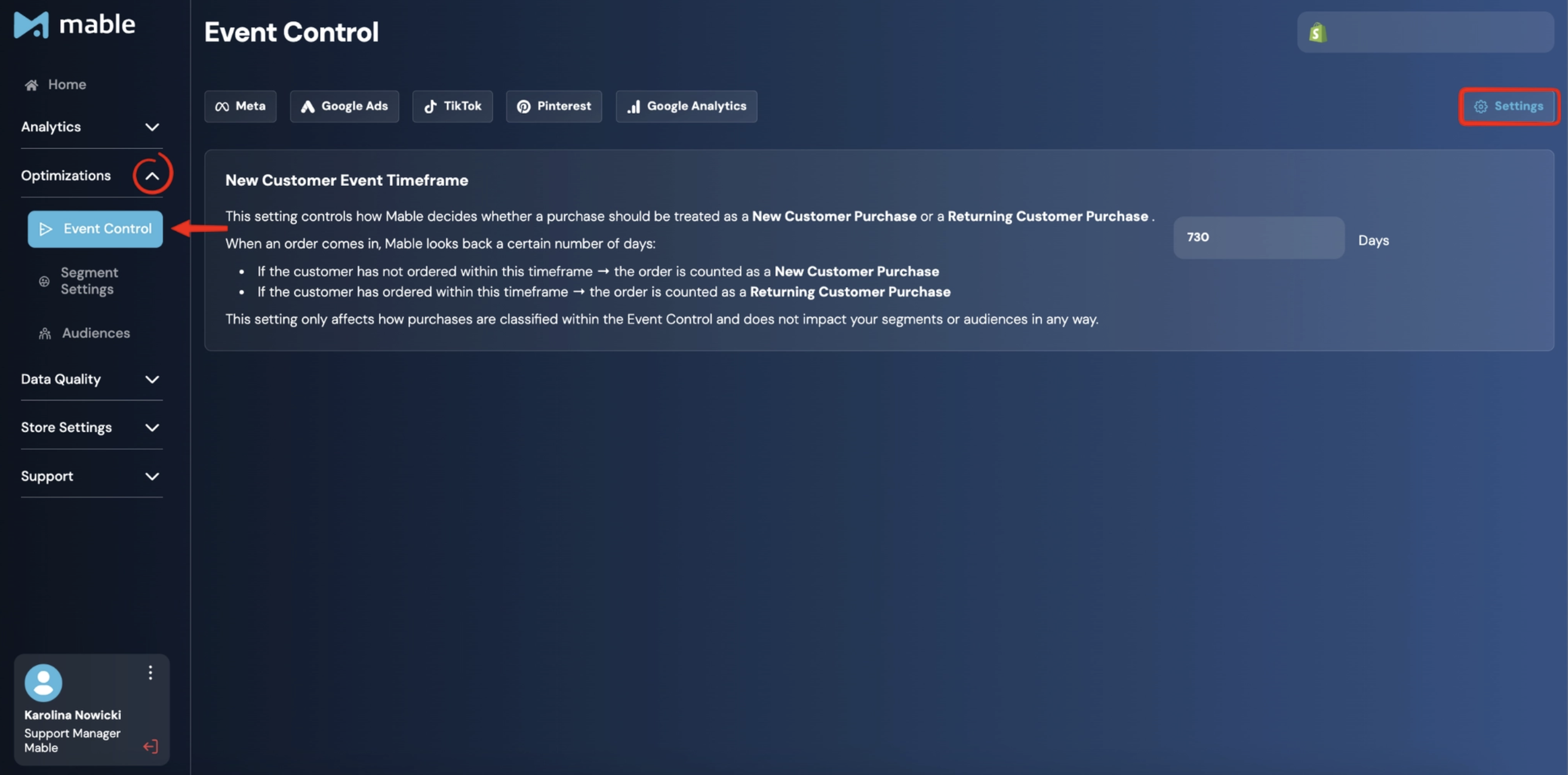
In the Settings tab of the Event Control Screen you can configure the New Customer Event Timeframe.
The New Customer Event Timeframe defines how long a customer is considered a Repeat Customer after making a purchase. Once the configured timeframe has passed, a future purchase can be classified as a First-time Customer again.
Where can you adjust the New Customer Event Timeframe?
Go to: Optimizations → Event Control → Settings
In the top-right corner of the Event Control screen, click Settings to access the New Customer Event Timeframe.
What does the timeframe control?
This setting is used exclusively for event classification within Event Control and directly impacts the customer signals sent to your advertising platforms. It does not impact customer segments or audiences defined in the Segments section.
Why is this setting important?
Many optimization strategies in Mable rely on the distinction between new and returning customers.
The New Customer Event Timeframe determines which purchases qualify for events such as:
NewCustomerPurchase
ReturningCustomerPurchase
As a result, this setting directly influences event reporting, optimization signals, and customer acquisition metrics.
Why does this differ from Shopify or Klaviyo?
Some platforms, such as Shopify or Klaviyo, use a lifetime-based customer definition. Once a customer has purchased, they are permanently classified as an existing customer.
Mable uses a timeframe-based approach. This means that customers who have not purchased within the configured timeframe can be classified as new customers again.
Because of this difference, customer acquisition metrics and new customer rates in Mable may not always match those shown in Shopify, Klaviyo, or other reporting tools.
What happens if you change the timeframe? Does the change affect historical reporting?
Changing the timeframe affects how future incoming events are classified.
In general:
A shorter timeframe increases the number of purchases classified as new customer purchases.
A longer timeframe decreases the number of purchases classified as returning customer purchases.
Changes are not applied retroactively. Customer classification is determined when an event is received and stored with the event. As a result, existing reports remain unchanged and only future events use the updated timeframe.
What is the recommended setup?
For most brands, we recommend keeping the default setting: 730 days (2 years)
This timeframe has proven to be the most reliable balance between accurately measuring customer acquisition and maintaining consistent reporting across channels.
We recommend changing this setting only if you have a clear business reason to do so, as it directly affects your new customer rate and may make future reporting less comparable to previous periods.
Why does Mable use a timeframe-based definition?
The purpose of the New Customer Feature is to help brands to focus on customer acquisition to scale, rather than wasting budget on customers who are already engaged with the brand and can be reached through cheaper, owned channels (email marketing, loyalty programs, organic…).
However, this logic changes when a customer has been inactive for a long period of time.
If a customer has not purchased for several years despite receiving email campaigns, newsletters, and other retention efforts, the owned channels have effectively failed to reactivate them. At this point, the customer behaves more like a new prospect than an active customer, which is why you want to target them with ads again.
For this reason, Mable uses a timeframe-based definition instead of a strict lifetime-based definition. Customers who have not purchased within the configured timeframe can be treated as new customers again, allowing advertising platforms to optimize toward reactivating valuable dormant customers.
This approach aligns customer classification more closely with the business goal of profitable customer acquisition rather than a purely technical definition of whether a customer has ever purchased before.
Can I use a lifetime-based definition instead?
Yes, if you want a customer to be considered "new" only on their very first purchase and never again afterwards, simply configure a very long timeframe that covers your entire relevant customer history, like 5-10 years.
With a sufficiently long timeframe, a customer will effectively remain a returning customer for life after their first purchase.